
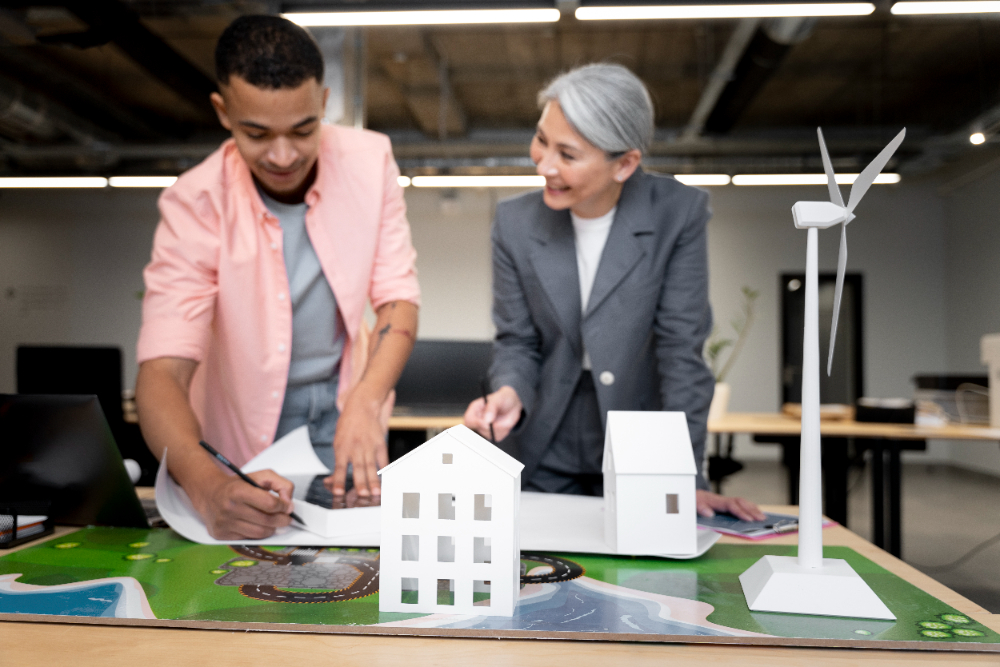
The science behind sustainable construction is discovering superior construction practices that are less damaging to our environment, while still affording the same comfort, innovation, and safety measures that modern construction has gifted us with.
Construction has been a core reason why the global economy and quality of life have boomed for people all across the globe. To meet the demands of an ever-growing population, the origins of construction would use the abundance of natural resources we find across the earth to provide shelter, housing, commercial spaces and infrastructure for cities and countries worldwide.
As the years have gone by and the success of the construction industry paved the way for a continuously growing population, the negative effects of such construction practices have slowly come to light alongside the climate changes and the research being done to see how we might prevent negative outcomes on our world.
This leads us to today, where contemporary construction companies and practices have been trying to align themselves with the latest science, evidence and data to address any problems caused by historical approaches in order to create a more sustainable, environmentally friendly and people-centred industry.
Sustainable construction is any construction practice that considers the long-term implications of both the raw and natural resources it uses, the energy consumed during the construction process, and the longevity and energy consumption of a project throughout its intended lifetime. In simple terms, the more renewable the resource, the more renewable the energy, and the more energy efficient the final project, the more sustainable the construction project will be.
Construction has a negative effect when it exploits natural resources at the expense of the environment, harvesting faster than nature can produce, with raw resources like sand for cement taking thousands of years to produce naturally. It has negative effects when it relies heavily on sources of energy, like fossil fuels, whose supply is slowly running out and whose use contributes to greenhouse gas emissions and poorer air quality.
So researching and implementing alternative sources for materials as well as alternative sources for energy is at the heart of sustainable construction. The final consideration is in the function and utility of the finished building and the way it will consume energy over its lifetime. Making buildings more insulated, using STS Construction Boards for instance, will ensure that maintaining a comfortable temperature for its occupants takes a significantly smaller amount of energy and that the heat will remain in the building for a significantly longer period.
The Importance of Sustainable Construction
In terms of raw data, at present the construction industry is, according to the United Nations Environment Programme, the largest single emitter of greenhouse gases, contributing to 37% of global emissions, as well as being responsible for consuming around 30% of global raw materials.
As greenhouse emissions are the single greatest driver in human accelerated climate change, and given the fact that our resources are finite and will run out eventually, sustainable construction becomes incredibly important to balance the needs of human beings, and our societies, with the needs of the environment and the world we all share to preserve it for future generations.
Ways to Make Construction More Sustainable
Thankfully, the ingenuity of the science that has helped to point out the negative impact of the construction industry on our world is also providing solutions for this necessary industry to continue to perform its role whilst safeguarding the future of the planet and environment. With a few key considerations being targeted for the largest impact, we can begin to make significant changes to the construction industry and pave the way for more sustainable practices across other industries too.
First up is Renewable Energy. Everything requires energy to run, from human beings to plants, to construction equipment and computers, without energy our world wouldn’t be the same. So developing sources of energy that are renewable is key to not just the improvement of construction practices but to all industries across the world, from fossil fuels to global power, vehicles and more.
Renewable energy can come in many forms, from wind and solar power to tidal power and hydroelectric dams, along with innovations in biofuels that can be grown easily to replace the extraction of oil, and finding the right combination of these to meet global demands for energy is going to be a global effort.
In the construction industry, we can certainly make the shift to electric vehicles and tools where possible whilst investing in the global efforts to switch every national grid to renewable resources. There has been significant innovation in the use of modular batteries and portable solar panels, which allow the transportation of small electric power plants that gather the Sun’s energy to store in the modular batteries and be used to power machinery and tools on site.
Next up is considering Sustainable Building Materials, which are materials whose resources are renewable, long-lasting, and often recyclable. Resources like the sand used in cement take thousands of years to produce, so finding new ways to create concrete by mixing it with other substances allows the limited supply of resources we have to go much further. You will find this in things like the STS Construction Board and the NoMorePly Fibre Cement Boards, which mix organic cement with cellulose fibres, these fibres provide a large bulk of the cement board makeup, allowing us to create strong concrete products with a significantly smaller portion of sand. Further to this, boards such as these provide excellent insulation and can contribute to reducing emissions and energy consumption in the completed project, thus playing a role in making the building sustainable not just during its construction phase, but for the lifetime of its operational phase too.
Alongside sustainable concrete solutions, we can use wood, with many options to choose from. Bamboo, whilst technically grass, is poised to replace wood in many places and fact is used heavily as scaffolding in China and across Asia already. It grows extremely quickly and depending on how it is treated can straddle the line between flexibility and strength like few other materials can. Its extremely quick growing and processing period, which requires very little land or resources, makes it a number one contender for a sustainable building material of the future.
Finally, we have the use of Plastic Construction Materials, which is maybe not what you’d expect to find in a blog about sustainability. But whilst plastic waste causes untold harm to the world’s oceans and wildlife due to its inability to degrade quickly, this same material, if utilised in construction may be the world’s saving grace.
Sustainable Construction requires long-lasting materials, and therefore energy efficient, if we can make a plastic brick that lasts 500 years for less energy than a clay brick that lasts 100 years, then the plastic brick provides us with a greater benefit. Advancements in science have also begun to find ways to create biodegradable plastics using fungi and bacteria to break them back down to their original chemical constituents.
Our Sustainability Commitments
For our role in all of this, we at STS-UK have dedicated ourselves to making our businesses sustainable in a variety of ways. In the way we design, distribute, and produce our products, our minds are constantly on how can improve the process and produce a better industry for all. To this end we:
- Reduce Waste: We are dedicated to creating a ‘closed-loop’ system, in which no material ends up at a landfill, but all can be reused and repurposed and placed back into the production process. Our packaging increasingly includes recycled content and we continue to work with our partners to address ways in which we can minimise waste across our supply chain.
- Promoting Energy-Efficient Products: Products like our STS Construction Board and NoMorePly Fibre Cement Board are designed to enhance thermal insulation and therefore contribute to lower energy consumption in the buildings that use them during their operation.
- Investing in Renewable Energy: On-site we have managed to integrate electric-powered forklifts and EV charging stations to reduce emissions associated with our operations and by the end of 2025 want to have only electric/hybrid vehicles in our fleet, as well as the installation of Solar Panels at our HQ.
- Innovating Sustainability: We ensure products, like our NoMorePly Fibre Cement Boards are recyclable and reusable, and will continue to embrace innovative materials like recyclable plastics to push the boundaries of what is possible during construction.
- To The Future: Looking ahead we want to achieve Net Zero Carbon emissions by 2050 so that our entire process becomes negligible in its effects on the environment.
Conclusion
With a rapidly changing and growing world, it is no surprise to see the construction industry contributing some of the largest emissions and use of natural resources the planet has ever seen. But without those contributions, we would not have much of the comfort, luxury, and security we see in our world today. But now we are better placed to bring sustainability and renewability to our construction practices it is something all construction companies as well as governments should embrace and invest in, to safeguard the future of our planet.
At STS-UK we are committed to this brighter future where construction provides its untold benefits to us all without creating any undue harm to the environment we construct within. If you want to partner with a sustainable construction company or learn more about our sustainable vision then reach out to STS-UK today, we’d be delighted to show you the way.
